
Why Korean Babies Stay Home for 100 Days: A Guide to Newborn Culture in Korea
Table of Contents
- What Is Baek-il (백일)?
- Does Every Korean Family Do This?
- The Immunity Question
- The Role of Grandparents
- Sanhujori — And Why Moms Are Resting Too
- What Actually Happens at Baek-il
- How It’s Changing Today
- FAQ
When I had my daughter, one of the first things I noticed was how differently people around me approached those early weeks.
Friends from abroad were sending photos of their newborns at coffee shops, on walks through the park, at family gatherings — all within the first few weeks of birth. Meanwhile, I was fielding calls from my mother and mother-in-law reminding me, gently but firmly, that the baby should not be going anywhere until at least 백일 (baek-il). One hundred days.
It’s one of those aspects of Korean parenting culture that looks, from the outside, like an inexplicable rule. But it isn’t a rule at all. It’s something more layered than that — a mix of history, practical wisdom, family love, and tradition that has shifted over generations but hasn’t disappeared. And once you understand where it comes from, it starts to make a different kind of sense.
What Is Baek-il (백일)?
Baek-il literally means “one hundred days.” In Korean tradition, a baby’s 100th day of life has long been considered a significant milestone — not just a birthday, but a threshold.
The reason goes back further than most people realize. Before modern medicine, infant mortality in Korea was high. Many babies didn’t survive their first months. Making it to 100 days was genuinely cause for celebration — a sign that this child was strong, that the family had something to be grateful for. Families would gather, prepare food, and mark the occasion with real meaning.
That context has faded in the age of neonatal care and pediatric medicine, but the cultural weight of the day hasn’t. Most Korean families still acknowledge baek-il, even if the way they observe it has changed.
Does Every Korean Family Actually Do This?
Here’s where I want to push back on the way this tradition is often described to outsiders: it is not a rule, and it’s not uniform.
“No going out until 100 days” is not a medical guideline. It’s not a government recommendation. It’s a cultural norm — which means it exists on a spectrum, and different families practice it differently.
Some parents are quite strict about it, avoiding anywhere crowded until the 100-day mark. Others start gentle neighborhood walks within the first few weeks. Many land somewhere in the middle: avoiding busy indoor spaces — shopping malls, department stores, packed restaurants, rush-hour public transit — while being comfortable with quiet outdoor walks or necessary medical appointments.
What most Korean parents do share, regardless of how strictly they observe the tradition, is a general carefulness about where a newborn goes in those early months. The 100-day mark tends to be when families feel ready to open up — cafés, extended family gatherings, the kinds of outings that involve being around a lot of people.
The Immunity Question
There’s a practical layer underneath the tradition that holds up to modern scrutiny.
Newborns have immune systems that aren’t yet fully developed. They’re genuinely more vulnerable to respiratory viruses, colds, and flu than older babies — and that vulnerability is highest in the earliest weeks. Korean parents tend to be particularly cautious about crowded indoor environments: department stores, malls, kids’ cafés, packed family events.
Since the pandemic, this caution has only deepened. What was once a cultural norm now also has a layer of lived experience behind it.
What most parents are comfortable with from early on: pediatric appointments, vaccinations, health screenings, short walks in the fresh air. It’s not isolation — it’s selective exposure.
→ Related: [Navigating Pediatric Healthcare in Seoul — A Parent’s Guide]
The Role of Grandparents
If you’re raising a child in Korea, you will almost certainly hear this at some point — from a grandparent, a family friend, an aunt, someone:
“아직 너무 어려. 백일 지나고 나가.”
(“She’s still too young. Wait until 100 days.”)
It can feel, especially to parents from other cultural backgrounds, like an instruction or a criticism. But in most cases it isn’t either. It’s an expression of worry and love from people who come from a generation where losing a baby wasn’t unthinkable, and where protecting a newborn was something the whole family participated in.
Understanding that context doesn’t mean you have to follow the same approach. But it does change how the conversation feels.
Sanhujori — And Why Moms Are Resting Too
The 100-day home period doesn’t only involve the baby. It also overlaps with 산후조리 (sanhujori) — Korea’s postpartum recovery tradition, which takes the mother’s healing seriously in a way that many other cultures don’t.
In the weeks after birth, many Korean mothers focus on rest, nutritious food, physical recovery, and bonding with the baby. Stress is minimized. Visitors are managed. Many mothers spend one to three weeks at a 산후조리원 (postnatal care center) — a dedicated facility that handles newborn care, meals, and recovery support so that mothers can actually heal.
When both mother and baby are in recovery mode, it naturally follows that the household turns inward for a while. The outside world can wait.
→ Related: [Giving Birth in South Korea: The Hospital System and My Experience]
What Actually Happens at Baek-il
When the 100th day arrives, most Korean families mark it — and the celebration is genuinely lovely.
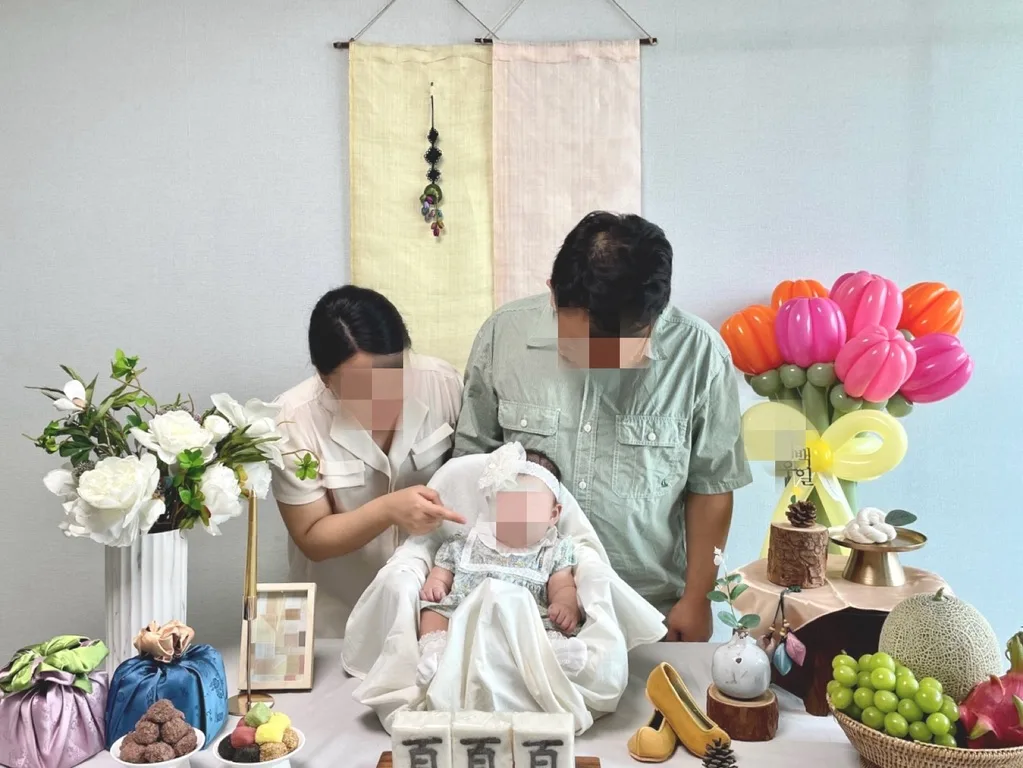
The scale varies. Some families host a 백일잔치 (baek-il jantchi) with grandparents and close relatives, a proper gathering with food and photographs. Others do something quieter: a small table set at home, a few photos, a moment to mark the milestone together.
The traditional baek-il table includes:
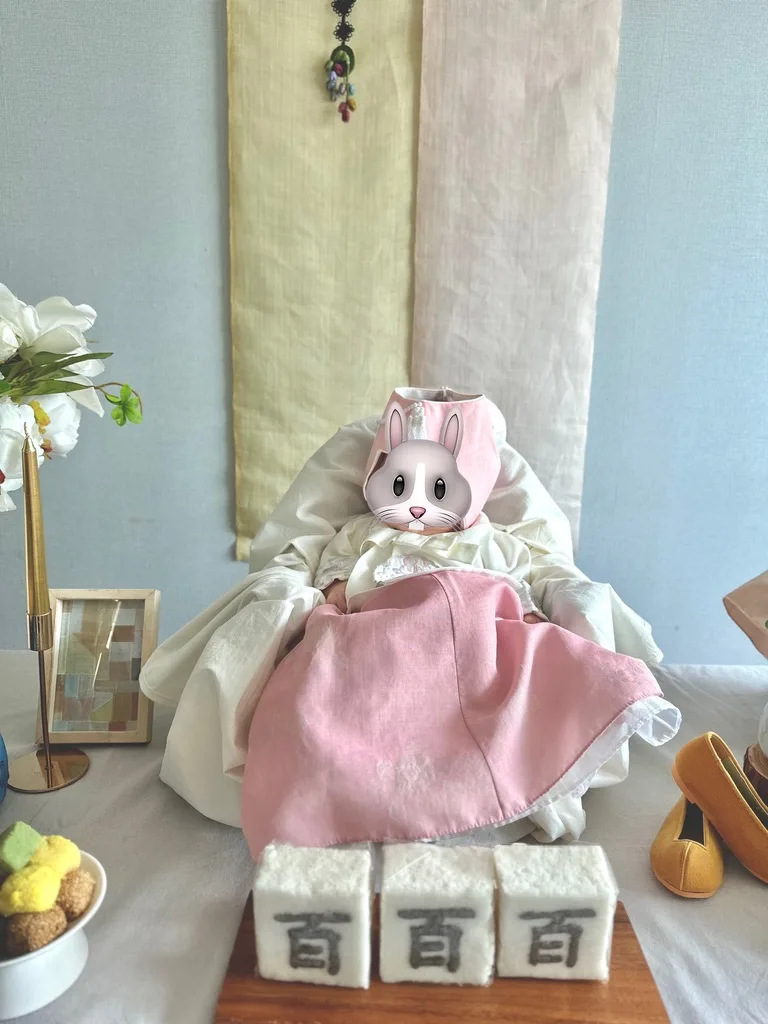
- 백설기 — white steamed rice cake, representing purity
- 오색떡 — five-colored rice cake, symbolizing luck and health
- Fresh fruit
- Flowers
- Decorative elements wishing the baby health and happiness
Many families also book a professional photo studio session for baek-il portraits — the Korean equivalent of newborn photos, just delayed by three months and, in my experience, considerably more elaborate.
It’s smaller than a 돌잔치 (first birthday celebration), but for families, it carries its own weight.
How It’s Changing Today
The tradition is softening at the edges, the way most traditions do across generations.
Younger Korean parents tend to be more flexible. If the weather is good, a stroller walk before 100 days is increasingly normal. Many parents prioritize their pediatrician’s advice over family expectations. The strict “do not leave the house” interpretation is less common than it used to be.
What hasn’t changed is the underlying instinct: Korean parents tend to be more measured than many Western counterparts about where newborns go in their earliest weeks, particularly when it comes to crowded indoor spaces. The form is shifting; the care behind it isn’t.
FAQ
What is baek-il in Korean culture?
Baek-il (백일) is the celebration of a baby’s 100th day of life. It originated as a milestone marking a baby’s survival past the most vulnerable early weeks, when infant mortality was high. Today it’s observed as a meaningful family celebration, often with traditional rice cakes, fruit, and a photo session.
Do Korean babies really not go outside for 100 days?
Not exactly. It’s a cultural tradition, not a medical rule. Many parents avoid crowded indoor spaces during this time, but short outdoor walks and necessary medical appointments are common from early on. The strictness varies by family.
What food is served at a baek-il celebration?
The traditional baek-il table includes white rice cake (백설기), five-colored rice cake (오색떡), fresh fruit, and flowers. Each element carries a symbolic meaning related to the baby’s health and future happiness.
What is sanhujori?
Sanhujori (산후조리) is Korea’s postpartum recovery tradition, which emphasizes rest, nutrition, and healing for the mother in the weeks after birth. Many Korean mothers spend time at a dedicated postnatal care center (산후조리원) during this period.
Is the 100-day tradition still practiced in Korea today?
Yes, though it’s more flexible than it used to be. Most Korean families still mark baek-il as a milestone, and many are still thoughtful about avoiding crowded places with newborns — but the interpretation varies widely by family.
What happens at a baek-il party?
Families gather with grandparents and close relatives to celebrate, share traditional food, and take photos. Many also book a professional studio session for baek-il portraits. The scale ranges from a quiet home celebration to a small family gathering.
Did you observe the 100-day tradition with your baby? I’d love to hear how your family approached it.
Leave a Reply